


Find It® - Hidden Object Games
4.95.29K Reviews
App Specs
- Version
- 2.31.0
- Updated On
- License
- Free
- Downloads
- 5,000,000+
- Developer
- Guru Puzzle Game
- Categories
- Puzzle
- Platform
- Android, iOS
Screenshots



 Analysis by AppCompare
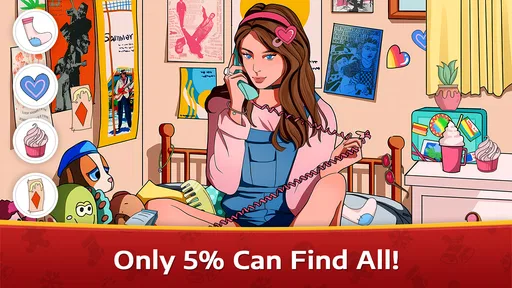
I spent time with Find It® as a relaxed hidden-object puzzle rather than a game I would rush through. Its basic appeal is easy to understand: each scene asks me to search for particular items, notice small visual details, and keep my attention on the picture until the answer becomes clear. That makes it a comfortable choice when I want something quiet, simple to start, and more mentally involving than passive scrolling.
The game comes from Guru Puzzle Game and sits in the puzzle category. It is free to install, aimed at Everyone, and supports devices running Android 7.0 or later. The current version is 2.31.0. Its popularity is also substantial, with an average rating of 4.9 from around 215 thousand ratings, more than 5 million installs, and roughly 5.3 thousand written reviews. Those figures do not replace personal testing, but they do suggest that the format has connected with a broad audience.
How the hidden-object experience works in everyday play
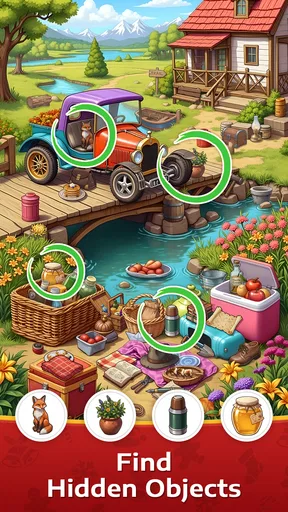
The central activity is visual searching. I look across an illustrated scene, compare what I see with the requested objects, and tap when I find a match. There is no complicated control scheme to learn, so the challenge comes from observation rather than dexterity. That is important because it changes the mood completely: this is closer to a digital seek-and-find book than to a fast puzzle that demands constant reactions.
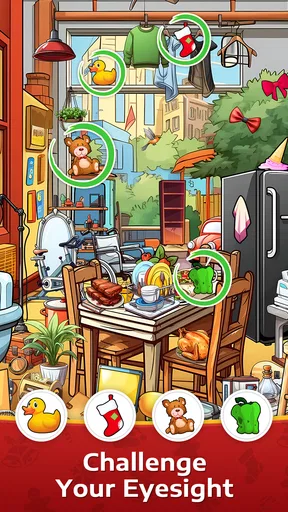
I found the best way to play was to divide each image into sections instead of scanning randomly. I would start at one corner, move across in a steady line, and then check the areas where colors, patterns, or object shapes blended together. This approach made the game feel less like guessing and more like a small visual investigation. It is also a useful habit for younger players, who may otherwise tap repeatedly without really examining the scene.
The scenes work best when I treat them as pictures with layers. A target may be easy to recognize by its outline but difficult to notice because it shares a color with the background. Another may be visible at first glance yet easy to ignore because it is surrounded by more interesting details. The game rewards patience, and that is where its brain-training appeal feels most believable: not because it teaches a formal subject, but because it encourages sustained attention and visual discrimination.
A calmer alternative to conventional puzzle games
Compared with match-three games, there is less emphasis on speed, chain reactions, or planning several moves ahead. Compared with word puzzles, there is no vocabulary barrier. Compared with action games, there is no pressure to react quickly. I would choose this one when I want a puzzle that can be paused mentally between searches and resumed without remembering a complicated strategy.
That relaxed design is also its main limitation. Players who enjoy the satisfaction of building a long combo, solving a logical grid, or beating a timer may find the searching too gentle. The pleasure here comes from noticing something that was already on the screen, not from creating a clever sequence of moves. Whether that feels rewarding depends almost entirely on how much you enjoy visual observation.
Worth Reading Before You Choose

EA SPORTS FC Mobile 26 Is a Bigger Football Game, but It Takes Time

Flipboard Shows What News Apps Must Do Beyond the Feed

Switching to Android Auto Means Rethinking Your Driving Routine

Google Calendar Makes a Crowded Week Easier to Manage

Ludo King Makes the Most of the Minutes Between Plans

Baby Panda World Brings Quick Play to Modern Phones, but Its Game Library Feels Busy
A realistic use case is a short break after work. I can open a scene, search for a few objects while having a coffee, and stop when my attention starts to fade. It does not require the emotional commitment of a story-driven game, and it is less mentally noisy than many free-to-play puzzle alternatives. For a parent, it can also offer a shared activity: one person searches the left side while another checks the right, turning a solitary puzzle into a quiet conversation.
What the free access means for value
The verified cost structure is straightforward enough to explain. The game is free, while in-app purchases are listed at $9.99 per item. That means I can try the core experience without paying up front, which is the right arrangement for a title whose appeal depends so much on whether its visual style and search rhythm suit me.
I see the free entry as the strongest part of the value proposition. Someone curious about hidden-object games does not have to commit to a paid download before learning whether the scenes feel enjoyable or repetitive. A family can also test it on a compatible device before deciding whether it deserves regular play. The important distinction is that “free” describes access to the game, not a promise that every optional purchase will be unnecessary for every player.
The listed purchase price gives me a clear point to consider before spending: I would only pay after deciding that I genuinely return to the game. If I play once, finish a few searches, and feel satisfied, the free access has already done its job. If I keep coming back and an optional item removes a recurring annoyance or adds lasting convenience, the purchase may feel reasonable. I would not treat it as automatic value simply because the game has a high rating.
For a value-conscious player, my advice is to use the free version as a trial rather than assuming that a purchase is part of the normal experience. Play it during the kind of break when you would actually use it, not only during the novelty period. That reveals more than a quick first impression: you will learn whether searching remains relaxing, whether you enjoy revisiting the format, and whether the visual challenge matches your preferred level of difficulty.
Small techniques that make searching more effective
My first practical tip is to avoid tapping every suspicious shape. Random tapping turns a visual puzzle into a trial-and-error exercise and makes the scene harder to read. Instead, I scan by texture. I look for unusual edges, repeated patterns, objects that interrupt a straight line, and items whose scale seems slightly wrong for their surroundings. Those clues are more reliable than simply searching for a familiar color.
My second tip is to change the distance between my eyes and the screen. When I look too closely, I focus on individual objects and lose the overall composition. When I sit back slightly, hidden outlines and mismatched shapes become easier to recognize. This is especially useful in busy scenes where several items overlap visually. It is a simple adjustment, but it can prevent the feeling that the game is unfair when the real problem is an overly narrow viewing habit.
A third useful workflow is to keep a mental list of object categories rather than repeating the exact word in my head. If I am looking for something small and rounded, I check containers, decorations, and tools together. If the target seems likely to have a distinctive silhouette, I scan for that silhouette even when the color does not match my expectation. This reduces tunnel vision, which is one of the biggest reasons I miss objects that are technically in plain sight.
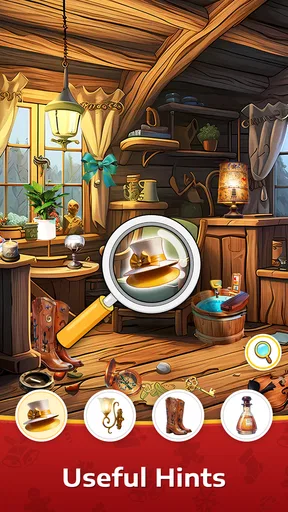
I also recommend taking a short pause before using any available assistance. Looking away for a moment and returning with fresh eyes often works better than staring harder. The break resets my attention and helps me notice an area I had unconsciously skipped. That makes the game more satisfying because I solve the scene through observation instead of immediately outsourcing the search.
Where the experience can lose momentum
The same simplicity that makes the game accessible can make it feel repetitive for experienced puzzle players. The basic action remains searching and tapping, so the long-term appeal depends on the variety and presentation of the scenes rather than on a growing set of mechanics. I would not choose it for deep strategic progression. I would choose it for a dependable visual activity that does not demand much preparation.
There is also a difference between relaxing difficulty and frustrating obscurity. When an item blends into the background, I enjoy the discovery. When I need to inspect every tiny area with no useful visual clue, the search becomes less about perception and more about persistence. Players who have limited patience for pixel-level hunting should keep that tradeoff in mind before investing time or money.
The age rating of Everyone makes the game broadly approachable, but that does not mean every player will enjoy the same level of challenge. Younger users may benefit from playing alongside an adult who encourages systematic scanning instead of random tapping. Older users who want a gentle attention exercise may appreciate the pace, although anyone looking for a serious cognitive-training program should not confuse a casual puzzle with a structured educational tool.
Another tradeoff is the lack of physical-world variety. A printed seek-and-find book offers a different kind of comfort, including the ability to mark a page and return later without a screen. A dedicated logic app may offer more measurable progression and greater variety in problem-solving. Find It® is more convenient when I want an immediate scene in my pocket, but it is not automatically the best option for every kind of puzzle mood.
Who is most likely to get real value from it
I would recommend this game to people who enjoy spotting details, illustrated scenes, and low-pressure challenges. It suits commuters, casual players, families sharing a device, and anyone who wants a short activity that can be started without learning a rules-heavy system. It is particularly approachable for someone who finds traditional logic puzzles intimidating but still wants to exercise concentration in a light way.
It can also work well as a screen-time compromise. Instead of opening a social feed during a brief pause, I can spend that time examining a scene with a clear goal. The session still feels casual, but it asks me to participate rather than consume. That does not make every minute productive, and I would not oversell the brain-training claim, yet the active observation is more engaging than simply watching content pass by.
I would be more cautious about recommending it to players who need strong progression, competitive rankings, elaborate stories, or a constant stream of new mechanics. If your favorite puzzle games are built around planning, deduction, or speed records, the hidden-object format may feel too narrow. I would also skip it if you dislike searching through visually crowded images or become irritated when the final object takes longer to identify than the earlier ones.
For children, the Everyone rating makes the age range broad, but the best experience will depend on how independently they can read the requests and interpret the scenes. For adults, the value is less about age and more about temperament. Patient observers will probably get more from it than players who want immediate feedback after every tap.
My verdict on downloading or skipping
My recommendation is to download it if you want a free, calm hidden-object puzzle that can fill short breaks without demanding fast reflexes. The free access makes experimentation easy, and the strong average rating alongside more than 5 million installs shows that the format has found a sizeable audience. I would begin with no purchase expectation, play naturally for several sessions, and judge the value by whether I voluntarily return to another scene.
I would skip it if you are searching for a complex puzzle system, a competitive challenge, or a game where every session feels mechanically different. The experience is intentionally focused, and that focus can feel soothing or repetitive depending on your taste. Its listed $9.99 in-app purchase price per item also means I would think carefully before spending: the free starting point is enough to decide whether the game belongs in your routine.
Overall, Guru Puzzle Game has made a sensible choice by keeping the interaction familiar and accessible. In my experience, the strongest moments come when I stop rushing, scan methodically, and suddenly notice an object that had been hiding in an obvious place. The best reason to try it is not the promise of endless novelty, but the simple satisfaction of paying attention. If that kind of quiet discovery sounds appealing, Find It® is an easy recommendation to test at no initial cost. If you need deeper mechanics, choose a more demanding puzzle style instead.
Pros
- Relaxing gameplay suitable for short breaks.
- Many scenes offer a satisfying challenge without being frustrating.
- Clear object lists make goals easy to understand.
- Works well for players who enjoy visual observation.
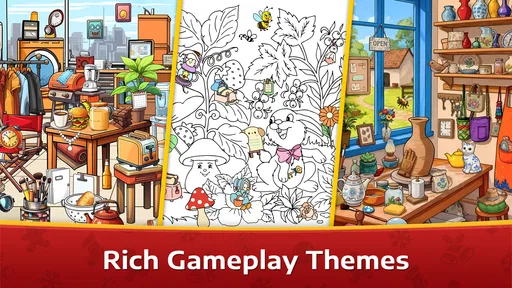
- Regular level variety helps keep the experience fresh.
Cons
- Some objects blend into busy backgrounds too easily.
- Hints may be limited unless earned or purchased.
- Later levels can feel repetitive after extended play.
- Small items may be difficult to spot on phone screens.
- Ads can interrupt the flow between puzzle scenes.
FAQs for Find It® - Hidden Object Games
What is Find It® - Hidden Object Games?
Find It® - Hidden Object Games is a casual puzzle game focused on spotting carefully hidden items within detailed illustrated scenes. Each level challenges you to compare the picture with a list of objects and locate them as quickly as possible. It is designed for short play sessions, making it suitable for relaxing at home or passing time while traveling.
How do you play Find It® - Hidden Object Games?
The basic gameplay is straightforward: open a scene, review the objects you need to find, and tap each item when you discover it. Some objects are blended into the background, partially covered, or drawn in unusual sizes, so careful observation is important. Depending on the level, hints or other assistance may be available if you become stuck.
Is Find It® - Hidden Object Games free to download and play?
The game can generally be downloaded without an upfront purchase, but the available experience may include advertising, optional in-app purchases, or both. These extras can provide hints, remove advertisements, or unlock additional content. Before downloading, it is worth checking the current store listing for pricing, subscription details, and any limitations on the free version.
Does Find It® - Hidden Object Games require an internet connection?
An internet connection may be useful or required for advertisements, analytics, updates, and certain online features, although some previously downloaded scenes may work offline. The exact behavior can vary by device and version of the game. If you plan to play while traveling without mobile data, test the game in airplane mode after installation.
Is Find It® - Hidden Object Games suitable for children?
The simple tap-to-find format is generally accessible to children, casual players, and adults who enjoy visual puzzles. However, parents should review the app’s age rating, advertising, in-app purchase options, and privacy information before allowing younger children to play. Some scenes may become challenging, and children could accidentally tap advertisements or purchase optional hints without supervision.


